of Saradwan, he made the Kshatriyas kill each other in the terrific war that ensued.'
"And Dhritarashtra hearing the ill news of the success of the Pandavas and recollecting the resolutions of Duryodhana, Kama, and Sakuni, pondered for a while and addressed to Sanjaya the following speech:--
'Attend, O Sanjaya, to all I am about to say, and it will not become thee to treat me with contempt. Thou art well-versed in the shastras, intelligent and endowed with wisdom. My inclination was never to war, not did I delight in the destruction of my race. I made no distinction between my own children and the children of Pandu. My own sons were prone to wilfulness and despised me because I am old. Blind as I am, because of my miserable plight and through paternal affection, I bore it all. I was foolish alter the thoughtless Duryodhana ever growing in folly. Having been a spectator of the riches of the mighty sons of Pandu, my son was derided for his awkwardness while ascending the hall. Unable to bear it all and unable himself to overcome the sons of Pandu in the field, and though a soldier, unwilling yet to obtain good fortune by his own exertion, with the help of the king of Gandhara he concerted an unfair game at dice.
'Hear, O Sanjaya, all that happened thereupon and came to my knowledge. And when thou hast heard all I say, recollecting everything as it fell out, thou shall then know me for one with a prophetic eye. When I heard that Arjuna, having bent the bow, had pierced the curious mark and brought it down to the ground, and bore away in triumph the maiden Krishna, in the sight of the assembled princes, then, O Sanjaya I had no hope of success. When I heard that Subhadra of the race of Madhu had, after forcible seizure been married by Arjuna in the city of Dwaraka, and that the two heroes of the race of Vrishni (Krishna and Balarama the brothers of Subhadra) without resenting it had entered Indraprastha as friends, then, O Sanjaya, I had no hope of success. When I heard that Arjuna, by his celestial arrow preventing the downpour by Indra the king of the gods, had gratified Agni by making over to him the forest of Khandava, then, O Sanjaya, I had no hope of success. When I heard that the five Pandavas with their mother Kunti had escaped from the house of lac, and that Vidura was engaged in the accomplishment of their designs, then, O Sanjaya, I had no hope of success. When I heard that Arjuna, after having pierced the mark in the arena had won Draupadi, and that the brave Panchalas had joined the Pandavas, then, O Sanjaya, I had no hope of success. When I heard that Jarasandha, the foremost of the royal line of Magadha, and blazing in the midst of the Kshatriyas, had been slain by Bhima with his bare arms alone, then, O Sanjaya, I had no hope of success. When I heard that in their general campaign the sons of Pandu had conquered the chiefs of the land and performed the grand sacrifice of the Rajasuya, then, O Sanjaya, I had no hope of success. When I heard that Draupadi, her voice choked with tears and heart full of agony,
Tuesday, June 9, 2009

THE MAHABHARATA ADI PARVA Section I Page 7
their welcome be proclaimed!' As these acclamations ceased, the plaudits of invisible spirits, causing every point of the heavens to resound, were tremendous. There were showers of sweet-scented flowers, and the sound of shells and kettle-drums. Such were the wonders that happened on the arrival of the young princes. The joyful noise of all the citizens, in expression of their satisfaction on the occasion, was so great that it reached the very heavens in magnifying plaudits.
Having studied the whole of the Vedas and sundry other shastras, the Pandavas resided there, respected by all and without apprehension from any one.
The principal men were pleased with the purity of Yudhishthira, the courage of Arjuna, the submissive attention of Kunti to her superiors, and the humility of the twins, Nakula and Sahadeva; and all the people rejoiced in their heroic virtues.
After a while, Arjuna obtained the virgin Krishna at the swayamvara, in the midst of a concourse of Rajas, by performing a very difficult feat of archery. And from this time he became very much respected in this world among all bowmen; and in fields of battle also, like the sun, he was hard to behold by foe-men. And having vanquished all the neighbouring princes and every considerable tribe, he accomplished all that was necessary for the Raja (his eldest brother) to perform the great sacrifice called Rajasuya.
Yudhishthira, after having, through the wise counsels of Vasudeva and by the valour of Bhimasena and Arjuna, slain Jarasandha (the king of Magadha) and the proud Chaidya, acquired the right to perform the grand sacrifice of Rajasuya abounding in provisions and offering and fraught with transcendent merits. And Duryodhana came to this sacrifice; and when he beheld the vast wealth of the Pandavas scattered all around, the offerings, the precious stones, gold and jewels; the wealth in cows, elephants, and horses; the curious textures, garments, and mantles; the precious shawls and furs and carpets made of the skin of the Ranku; he was filled with envy and became exceedingly displeased. And when he beheld the hall of assembly elegantly constructed by Maya (the Asura architect) after the fashion of a celestial court, he was inflamed with rage. And having started in confusion at certain architectural deceptions within this building, he was derided by Bhimasena in the presence of Vasudeva, like one of mean descent.
And it was represented to Dhritarashtra that his son, while partaking of various objects of enjoyment and diverse precious things, was becoming meagre, wan, and pale. And Dhritarashtra, some time after, out of affection for his son, gave his consent to their playing (with the Pandavas) at dice. And Vasudeva coming to know of this, became exceedingly wroth. And being dissatisfied, he did nothing to prevent the disputes, but overlooked the gaming and sundry other horried unjustifiable transactions arising therefrom: and in spite of Vidura, Bhishma, Drona, and Kripa, the son
Having studied the whole of the Vedas and sundry other shastras, the Pandavas resided there, respected by all and without apprehension from any one.
The principal men were pleased with the purity of Yudhishthira, the courage of Arjuna, the submissive attention of Kunti to her superiors, and the humility of the twins, Nakula and Sahadeva; and all the people rejoiced in their heroic virtues.
After a while, Arjuna obtained the virgin Krishna at the swayamvara, in the midst of a concourse of Rajas, by performing a very difficult feat of archery. And from this time he became very much respected in this world among all bowmen; and in fields of battle also, like the sun, he was hard to behold by foe-men. And having vanquished all the neighbouring princes and every considerable tribe, he accomplished all that was necessary for the Raja (his eldest brother) to perform the great sacrifice called Rajasuya.
Yudhishthira, after having, through the wise counsels of Vasudeva and by the valour of Bhimasena and Arjuna, slain Jarasandha (the king of Magadha) and the proud Chaidya, acquired the right to perform the grand sacrifice of Rajasuya abounding in provisions and offering and fraught with transcendent merits. And Duryodhana came to this sacrifice; and when he beheld the vast wealth of the Pandavas scattered all around, the offerings, the precious stones, gold and jewels; the wealth in cows, elephants, and horses; the curious textures, garments, and mantles; the precious shawls and furs and carpets made of the skin of the Ranku; he was filled with envy and became exceedingly displeased. And when he beheld the hall of assembly elegantly constructed by Maya (the Asura architect) after the fashion of a celestial court, he was inflamed with rage. And having started in confusion at certain architectural deceptions within this building, he was derided by Bhimasena in the presence of Vasudeva, like one of mean descent.
And it was represented to Dhritarashtra that his son, while partaking of various objects of enjoyment and diverse precious things, was becoming meagre, wan, and pale. And Dhritarashtra, some time after, out of affection for his son, gave his consent to their playing (with the Pandavas) at dice. And Vasudeva coming to know of this, became exceedingly wroth. And being dissatisfied, he did nothing to prevent the disputes, but overlooked the gaming and sundry other horried unjustifiable transactions arising therefrom: and in spite of Vidura, Bhishma, Drona, and Kripa, the son
THE MAHABHARATA ADI PARVA Section I Page 6
Vyasa hath fully represented the greatness of the house of Kuru, the virtuous principles of Gandhari, the wisdom of Vidura, and the constancy of Kunti. The noble Rishi hath also described the divinity of Vasudeva, the rectitude of the sons of Pandu, and the evil practices of the sons and partisans of Dhritarashtra.
Vyasa executed the compilation of the Bharata, exclusive of the episodes originally in twenty-four thousand verses; and so much only is called by the learned as the Bharata. Afterwards, he composed an epitome in one hundred and fifty verses, consisting of the introduction with the chapter of contents. This he first taught to his son Suka; and afterwards he gave it to others of his disciples who were possessed of the same qualifications. After that he executed another compilation, consisting of six hundred thousand verses. Of those, thirty hundred thousand are known in the world of the Devas; fifteen hundred thousand in the world of the Pitris: fourteen hundred thousand among the Gandharvas, and one hundred thousand in the regions of mankind. Narada recited them to the Devas, Devala to the Pitris, and Suka published them to the Gandharvas, Yakshas, and Rakshasas: and in this world they were recited by Vaisampayana, one of the disciples of Vyasa, a man of just principles and the first among all those acquainted with the Vedas. Know that I, Sauti, have also repeated one hundred thousand verses.
Yudhishthira is a vast tree, formed of religion and virtue; Arjuna is its trunk; Bhimasena, its branches; the two sons of Madri are its full-grown fruit and flowers; and its roots are Krishna, Brahma, and the Brahmanas.
Pandu, after having subdued many countries by his wisdom and prowess, took up his abode with the Munis in a certain forest as a sportsman, where he brought upon himself a very severe misfortune for having killed a stag coupling with its mate, which served as a warning for the conduct of the princes of his house as long as they lived. Their mothers, in order that the ordinances of the law might be fulfilled, admitted as substitutes to their embraces the gods Dharma, Vayu, Sakra, and the divinities the twin Aswins. And when their offspring grew up, under the care of their two mothers, in the society of ascetics, in the midst of sacred groves and holy recluse-abodes of religious men, they were conducted by Rishis into the presence of Dhritarashtra and his sons, following as students in the habit of Brahmacharis, having their hair tied in knots on their heads. 'These our pupils', said they, 'are as your sons, your brothers, and your friends; they are Pandavas.' Saying this, the Munis disappeared.
When the Kauravas saw them introduced as the sons of Pandu, the distinguished class of citizens shouted exceedingly for joy. Some, however, said, they were not the sons of Pandu; others said, they were; while a few asked how they could be his offspring, seeing he had been so long dead. Still on all sides voices were heard crying, 'They are on all accounts welcome! Through divine Providence we behold the family of Pandu! Let
Vyasa executed the compilation of the Bharata, exclusive of the episodes originally in twenty-four thousand verses; and so much only is called by the learned as the Bharata. Afterwards, he composed an epitome in one hundred and fifty verses, consisting of the introduction with the chapter of contents. This he first taught to his son Suka; and afterwards he gave it to others of his disciples who were possessed of the same qualifications. After that he executed another compilation, consisting of six hundred thousand verses. Of those, thirty hundred thousand are known in the world of the Devas; fifteen hundred thousand in the world of the Pitris: fourteen hundred thousand among the Gandharvas, and one hundred thousand in the regions of mankind. Narada recited them to the Devas, Devala to the Pitris, and Suka published them to the Gandharvas, Yakshas, and Rakshasas: and in this world they were recited by Vaisampayana, one of the disciples of Vyasa, a man of just principles and the first among all those acquainted with the Vedas. Know that I, Sauti, have also repeated one hundred thousand verses.
Yudhishthira is a vast tree, formed of religion and virtue; Arjuna is its trunk; Bhimasena, its branches; the two sons of Madri are its full-grown fruit and flowers; and its roots are Krishna, Brahma, and the Brahmanas.
Pandu, after having subdued many countries by his wisdom and prowess, took up his abode with the Munis in a certain forest as a sportsman, where he brought upon himself a very severe misfortune for having killed a stag coupling with its mate, which served as a warning for the conduct of the princes of his house as long as they lived. Their mothers, in order that the ordinances of the law might be fulfilled, admitted as substitutes to their embraces the gods Dharma, Vayu, Sakra, and the divinities the twin Aswins. And when their offspring grew up, under the care of their two mothers, in the society of ascetics, in the midst of sacred groves and holy recluse-abodes of religious men, they were conducted by Rishis into the presence of Dhritarashtra and his sons, following as students in the habit of Brahmacharis, having their hair tied in knots on their heads. 'These our pupils', said they, 'are as your sons, your brothers, and your friends; they are Pandavas.' Saying this, the Munis disappeared.
When the Kauravas saw them introduced as the sons of Pandu, the distinguished class of citizens shouted exceedingly for joy. Some, however, said, they were not the sons of Pandu; others said, they were; while a few asked how they could be his offspring, seeing he had been so long dead. Still on all sides voices were heard crying, 'They are on all accounts welcome! Through divine Providence we behold the family of Pandu! Let
THE MAHABHARATA ADI PARVA Section I Page 5
by doing which, he dictated this work according to his engagement.
I am (continued Sauti) acquainted with eight thousand and eight hundred verses, and so is Suka, and perhaps Sanjaya. From the mysteriousness of their meaning, O Muni, no one is able, to this day, to penetrate those closely knit difficult slokas. Even the omniscient Ganesa took a moment to consider; while Vyasa, however, continued to compose other verses in great abundance.
The wisdom of this work, like unto an instrument of applying collyrium, hath opened the eyes of the inquisitive world blinded by the darkness of ignorance. As the sun dispelleth the darkness, so doth the Bharata by its discourses on religion, profit, pleasure and final release, dispel the ignorance of men. As the full-moon by its mild light expandeth the buds of the water-lily, so this Purana, by exposing the light of the Sruti hath expanded the human intellect. By the lamp of history, which destroyeth the darkness of ignorance, the whole mansion of nature is properly and completely illuminated.
This work is a tree, of which the chapter of contents is the seed; the divisions called Pauloma and Astika are the root; the part called Sambhava is the trunk; the books called Sabha and Aranya are the roosting perches; the books called Arani is the knitting knots; the books called Virata and Udyoga the pith; the book named Bhishma, the main branch; the book called Drona, the leaves; the book called Karna, the fair flowers; the book named Salya, their sweet smell; the books entitled Stri and Aishika, the refreshing shade; the book called Santi, the mighty fruit; the book called Aswamedha, the immortal sap; the denominated Asramavasika, the spot where it groweth; and the book called Mausala, is an epitome of the Vedas and held in great respect by the virtuous Brahmanas. The tree of the Bharata, inexhaustible to mankind as the clouds, shall be as a source of livelihood to all distinguished poets."
"Sauti continued, 'I will now speak of the undying flowery and fruitful productions of this tree, possessed of pure and pleasant taste, and not to be destroyed even by the immortals. Formerly, the spirited and virtuous Krishna-Dwaipayana, by the injunctions of Bhishma, the wise son of Ganga and of his own mother, became the father of three boys who were like the three fires by the two wives of Vichitra-virya; and having thus raised up Dhritarashtra, Pandu and Vidura, he returned to his recluse abode to prosecute his religious exercise.
It was not till after these were born, grown up, and departed on the supreme journey, that the great Rishi Vyasa published the Bharata in this region of mankind; when being solicited by Janamejaya and thousands of Brahmanas, he instructed his disciple Vaisampayana, who was seated near him; and he, sitting together with the Sadasyas, recited the Bharata, during the intervals of the ceremonies of the sacrifice, being repeatedly urged to proceed.
I am (continued Sauti) acquainted with eight thousand and eight hundred verses, and so is Suka, and perhaps Sanjaya. From the mysteriousness of their meaning, O Muni, no one is able, to this day, to penetrate those closely knit difficult slokas. Even the omniscient Ganesa took a moment to consider; while Vyasa, however, continued to compose other verses in great abundance.
The wisdom of this work, like unto an instrument of applying collyrium, hath opened the eyes of the inquisitive world blinded by the darkness of ignorance. As the sun dispelleth the darkness, so doth the Bharata by its discourses on religion, profit, pleasure and final release, dispel the ignorance of men. As the full-moon by its mild light expandeth the buds of the water-lily, so this Purana, by exposing the light of the Sruti hath expanded the human intellect. By the lamp of history, which destroyeth the darkness of ignorance, the whole mansion of nature is properly and completely illuminated.
This work is a tree, of which the chapter of contents is the seed; the divisions called Pauloma and Astika are the root; the part called Sambhava is the trunk; the books called Sabha and Aranya are the roosting perches; the books called Arani is the knitting knots; the books called Virata and Udyoga the pith; the book named Bhishma, the main branch; the book called Drona, the leaves; the book called Karna, the fair flowers; the book named Salya, their sweet smell; the books entitled Stri and Aishika, the refreshing shade; the book called Santi, the mighty fruit; the book called Aswamedha, the immortal sap; the denominated Asramavasika, the spot where it groweth; and the book called Mausala, is an epitome of the Vedas and held in great respect by the virtuous Brahmanas. The tree of the Bharata, inexhaustible to mankind as the clouds, shall be as a source of livelihood to all distinguished poets."
"Sauti continued, 'I will now speak of the undying flowery and fruitful productions of this tree, possessed of pure and pleasant taste, and not to be destroyed even by the immortals. Formerly, the spirited and virtuous Krishna-Dwaipayana, by the injunctions of Bhishma, the wise son of Ganga and of his own mother, became the father of three boys who were like the three fires by the two wives of Vichitra-virya; and having thus raised up Dhritarashtra, Pandu and Vidura, he returned to his recluse abode to prosecute his religious exercise.
It was not till after these were born, grown up, and departed on the supreme journey, that the great Rishi Vyasa published the Bharata in this region of mankind; when being solicited by Janamejaya and thousands of Brahmanas, he instructed his disciple Vaisampayana, who was seated near him; and he, sitting together with the Sadasyas, recited the Bharata, during the intervals of the ceremonies of the sacrifice, being repeatedly urged to proceed.
Monday, June 8, 2009
THE MAHABHARATA ADI PARVA Section I Page 4
palms, he bowed and ordered a seat to be brought. And Vyasa having gone round him who is called Hiranyagarbha seated on that distinguished seat stood near it; and being commanded by Brahma Parameshthi, he sat down near the seat, full of affection and smiling in joy.
Then the greatly glorious Vyasa, addressing Brahma Parameshthi, said, "O divine Brahma, by me a poem hath been composed which is greatly respected. The mystery of the Veda, and what other subjects have been explained by me; the various rituals of the Upanishads with the Angas; the compilation of the Puranas and history formed by me and named after the three divisions of time, past, present, and future; the determination of the nature of decay, fear, disease, existence, and non-existence, a description of creeds and of the various modes of life; rule for the four castes, and the import of all the Puranas; an account of asceticism and of the duties of a religious student; the dimensions of the sun and moon, the planets, constellations, and stars, together with the duration of the four ages; the Rik, Sama and Yajur Vedas; also the Adhyatma; the sciences called Nyaya, Orthœphy and Treatment of diseases; charity and Pasupatadharma; birth celestial and human, for particular purposes; also a description of places of pilgrimage and other holy places of rivers, mountains, forests, the ocean, of heavenly cities and the kalpas; the art of war; the different kinds of nations and languages: the nature of the manners of the people; and the all-pervading spirit;--all these have been represented. But, after all, no writer of this work is to be found on earth.'
"Brahma said. 'I esteem thee for thy knowledge of divine mysteries, before the whole body of celebrated Munis distinguished for the sanctity of their lives. I know thou hast revealed the divine word, even from its first utterance, in the language of truth. Thou hast called thy present work a poem, wherefore it shall be a poem. There shall be no poets whose works may equal the descriptions of this poem, even, as the three other modes called Asrama are ever unequal in merit to the domestic Asrama. Let Ganesa be thought of, O Muni, for the purpose of writing the poem.'
"Sauti said, 'Brahma having thus spoken to Vyasa, retired to his own abode. Then Vyasa began to call to mind Ganesa. And Ganesa, obviator of obstacles, ready to fulfil the desires of his votaries, was no sooner thought of, than he repaired to the place where Vyasa was seated. And when he had been saluted, and was seated, Vyasa addressed him thus, 'O guide of the Ganas! be thou the writer of the Bharata which I have formed in my imagination, and which I am about to repeat."
"Ganesa, upon hearing this address, thus answered, 'I will become the writer of thy work, provided my pen do not for a moment cease writing." And Vyasa said unto that divinity, 'Wherever there be anything thou dost not comprehend, cease to continue writing.' Ganesa having signified his assent, by repeating the word Om! proceeded to write; and Vyasa began; and by way of diversion, he knit the knots of composition exceeding close;
Then the greatly glorious Vyasa, addressing Brahma Parameshthi, said, "O divine Brahma, by me a poem hath been composed which is greatly respected. The mystery of the Veda, and what other subjects have been explained by me; the various rituals of the Upanishads with the Angas; the compilation of the Puranas and history formed by me and named after the three divisions of time, past, present, and future; the determination of the nature of decay, fear, disease, existence, and non-existence, a description of creeds and of the various modes of life; rule for the four castes, and the import of all the Puranas; an account of asceticism and of the duties of a religious student; the dimensions of the sun and moon, the planets, constellations, and stars, together with the duration of the four ages; the Rik, Sama and Yajur Vedas; also the Adhyatma; the sciences called Nyaya, Orthœphy and Treatment of diseases; charity and Pasupatadharma; birth celestial and human, for particular purposes; also a description of places of pilgrimage and other holy places of rivers, mountains, forests, the ocean, of heavenly cities and the kalpas; the art of war; the different kinds of nations and languages: the nature of the manners of the people; and the all-pervading spirit;--all these have been represented. But, after all, no writer of this work is to be found on earth.'
"Brahma said. 'I esteem thee for thy knowledge of divine mysteries, before the whole body of celebrated Munis distinguished for the sanctity of their lives. I know thou hast revealed the divine word, even from its first utterance, in the language of truth. Thou hast called thy present work a poem, wherefore it shall be a poem. There shall be no poets whose works may equal the descriptions of this poem, even, as the three other modes called Asrama are ever unequal in merit to the domestic Asrama. Let Ganesa be thought of, O Muni, for the purpose of writing the poem.'
"Sauti said, 'Brahma having thus spoken to Vyasa, retired to his own abode. Then Vyasa began to call to mind Ganesa. And Ganesa, obviator of obstacles, ready to fulfil the desires of his votaries, was no sooner thought of, than he repaired to the place where Vyasa was seated. And when he had been saluted, and was seated, Vyasa addressed him thus, 'O guide of the Ganas! be thou the writer of the Bharata which I have formed in my imagination, and which I am about to repeat."
"Ganesa, upon hearing this address, thus answered, 'I will become the writer of thy work, provided my pen do not for a moment cease writing." And Vyasa said unto that divinity, 'Wherever there be anything thou dost not comprehend, cease to continue writing.' Ganesa having signified his assent, by repeating the word Om! proceeded to write; and Vyasa began; and by way of diversion, he knit the knots of composition exceeding close;
ADI PARVA Section I Page 3
the months, the fortnights, called Pakshas, with day and night in due succession. And thus were produced all things which are known to mankind.
And what is seen in the universe, whether animate or inanimate, of created things, will at the end of the world, and after the expiration of the Yuga, be again confounded. And, at the commencement of other Yugas, all things will be renovated, and, like the various fruits of the earth, succeed each other in the due order of their seasons. Thus continueth perpetually to revolve in the world, without beginning and without end, this wheel which causeth the destruction of all things.
The generation of Devas, in brief, was thirty-three thousand, thirty-three hundred and thirty-three. The sons of Div were Brihadbhanu, Chakshus, Atma Vibhavasu, Savita, Richika, Arka, Bhanu, Asavaha, and Ravi. Of these Vivaswans of old, Mahya was the youngest whose son was Deva-vrata. The latter had for his son, Su-vrata who, we learn, had three sons,--Dasa-jyoti, Sata-jyoti, and Sahasra-jyoti, each of them producing numerous offspring. The illustrious Dasa-jyoti had ten thousand, Sata-jyoti ten times that number, and Sahasra-jyoti ten times the number of Sata-jyoti's offspring. From these are descended the family of the Kurus, of the Yadus, and of Bharata; the family of Yayati and of Ikshwaku; also of all the Rajarshis. Numerous also were the generations produced, and very abundant were the creatures and their places of abode. The mystery which is threefold--the Vedas, Yoga, and Vijnana Dharma, Artha, and Kama--also various books upon the subject of Dharma, Artha, and Kama; also rules for the conduct of mankind; also histories and discourses with various srutis; all of which having been seen by the Rishi Vyasa are here in due order mentioned as a specimen of the book.
The Rishi Vyasa published this mass of knowledge in both a detailed and an abridged form. It is the wish of the learned in the world to possess the details and the abridgement. Some read the Bharata beginning with the initial mantra (invocation), others with the story of Astika, others with Uparichara, while some Brahmanas study the whole. Men of learning display their various knowledge of the institutes in commenting on the composition. Some are skilful in explaining it, while others, in remembering its contents.
The son of Satyavati having, by penance and meditation, analysed the eternal Veda, afterwards composed this holy history, when that learned Brahmarshi of strict vows, the noble Dwaipayana Vyasa, offspring of Parasara, had finished this greatest of narrations, he began to consider how he might teach it to his disciples. And the possessor of the six attributes, Brahma, the world's preceptor, knowing of the anxiety of the Rishi Dwaipayana, came in person to the place where the latter was, for gratifying the saint, and benefiting the people. And when Vyasa, surrounded by all the tribes of Munis, saw him, he was surprised; and, standing with joined
And what is seen in the universe, whether animate or inanimate, of created things, will at the end of the world, and after the expiration of the Yuga, be again confounded. And, at the commencement of other Yugas, all things will be renovated, and, like the various fruits of the earth, succeed each other in the due order of their seasons. Thus continueth perpetually to revolve in the world, without beginning and without end, this wheel which causeth the destruction of all things.
The generation of Devas, in brief, was thirty-three thousand, thirty-three hundred and thirty-three. The sons of Div were Brihadbhanu, Chakshus, Atma Vibhavasu, Savita, Richika, Arka, Bhanu, Asavaha, and Ravi. Of these Vivaswans of old, Mahya was the youngest whose son was Deva-vrata. The latter had for his son, Su-vrata who, we learn, had three sons,--Dasa-jyoti, Sata-jyoti, and Sahasra-jyoti, each of them producing numerous offspring. The illustrious Dasa-jyoti had ten thousand, Sata-jyoti ten times that number, and Sahasra-jyoti ten times the number of Sata-jyoti's offspring. From these are descended the family of the Kurus, of the Yadus, and of Bharata; the family of Yayati and of Ikshwaku; also of all the Rajarshis. Numerous also were the generations produced, and very abundant were the creatures and their places of abode. The mystery which is threefold--the Vedas, Yoga, and Vijnana Dharma, Artha, and Kama--also various books upon the subject of Dharma, Artha, and Kama; also rules for the conduct of mankind; also histories and discourses with various srutis; all of which having been seen by the Rishi Vyasa are here in due order mentioned as a specimen of the book.
The Rishi Vyasa published this mass of knowledge in both a detailed and an abridged form. It is the wish of the learned in the world to possess the details and the abridgement. Some read the Bharata beginning with the initial mantra (invocation), others with the story of Astika, others with Uparichara, while some Brahmanas study the whole. Men of learning display their various knowledge of the institutes in commenting on the composition. Some are skilful in explaining it, while others, in remembering its contents.
The son of Satyavati having, by penance and meditation, analysed the eternal Veda, afterwards composed this holy history, when that learned Brahmarshi of strict vows, the noble Dwaipayana Vyasa, offspring of Parasara, had finished this greatest of narrations, he began to consider how he might teach it to his disciples. And the possessor of the six attributes, Brahma, the world's preceptor, knowing of the anxiety of the Rishi Dwaipayana, came in person to the place where the latter was, for gratifying the saint, and benefiting the people. And when Vyasa, surrounded by all the tribes of Munis, saw him, he was surprised; and, standing with joined
ADI PARVA Section I Page 2
"The Rishi replied, 'The Purana, first promulgated by the great Rishi Dwaipayana, and which after having been heard both by the gods and the Brahmarshis was highly esteemed, being the most eminent narrative that exists, diversified both in diction and division, possessing subtile meanings logically combined, and gleaned from the Vedas, is a sacred work. Composed in elegant language, it includeth the subjects of other books. It is elucidated by other Shastras, and comprehendeth the sense of the four Vedas. We are desirous of hearing that history also called Bharata, the holy composition of the wonderful Vyasa, which dispelleth the fear of evil, just as it was cheerfully recited by the Rishi Vaisampayana, under the direction of Dwaipayana himself, at the snake-sacrifice of Raja Janamejaya?'
"Sauti then said, 'Having bowed down to the primordial being Isana, to whom multitudes make offerings, and who is adored by the multitude; who is the true incorruptible one, Brahma, perceptible, imperceptible, eternal; who is both a non-existing and an existing-non-existing being; who is the universe and also distinct from the existing and non-existing universe; who is the creator of high and low; the ancient, exalted, inexhaustible one; who is Vishnu, beneficent and the beneficence itself, worthy of all preference, pure and immaculate; who is Hari, the ruler of the faculties, the guide of all things moveable and immoveable; I will declare the sacred thoughts of the illustrious sage Vyasa, of marvellous deeds and worshipped here by all. Some bards have already published this history, some are now teaching it, and others, in like manner, will hereafter promulgate it upon the earth. It is a great source of knowledge, established throughout the three regions of the world. It is possessed by the twice-born both in detailed and compendious forms. It is the delight of the learned for being embellished with elegant expressions, conversations human and divine, and a variety of poetical measures.
In this world, when it was destitute of brightness and light, and enveloped all around in total darkness, there came into being, as the primal cause of creation, a mighty egg, the one inexhaustible seed of all created beings. It is called Mahadivya, and was formed at the beginning of the Yuga, in which we are told, was the true light Brahma, the eternal one, the wonderful and inconceivable being present alike in all places; the invisible and subtile cause, whose nature partaketh of entity and non-entity. From this egg came out the lord Pitamaha Brahma, the one only Prajapati; with Suraguru and Sthanu. Then appeared the twenty-one Prajapatis, viz., Manu, Vasishtha and Parameshthi; ten Prachetas, Daksha, and the seven sons of Daksha. Then appeared the man of inconceivable nature whom all the Rishis know and so the Viswe-devas, the Adityas, the Vasus, and the twin Aswins; the Yakshas, the Sadhyas, the Pisachas, the Guhyakas, and the Pitris. After these were produced the wise and most holy Brahmarshis, and the numerous Rajarshis distinguished by every noble quality. So the water, the heavens, the earth, the air, the sky, the points of the heavens, the years, the seasons,
"Sauti then said, 'Having bowed down to the primordial being Isana, to whom multitudes make offerings, and who is adored by the multitude; who is the true incorruptible one, Brahma, perceptible, imperceptible, eternal; who is both a non-existing and an existing-non-existing being; who is the universe and also distinct from the existing and non-existing universe; who is the creator of high and low; the ancient, exalted, inexhaustible one; who is Vishnu, beneficent and the beneficence itself, worthy of all preference, pure and immaculate; who is Hari, the ruler of the faculties, the guide of all things moveable and immoveable; I will declare the sacred thoughts of the illustrious sage Vyasa, of marvellous deeds and worshipped here by all. Some bards have already published this history, some are now teaching it, and others, in like manner, will hereafter promulgate it upon the earth. It is a great source of knowledge, established throughout the three regions of the world. It is possessed by the twice-born both in detailed and compendious forms. It is the delight of the learned for being embellished with elegant expressions, conversations human and divine, and a variety of poetical measures.
In this world, when it was destitute of brightness and light, and enveloped all around in total darkness, there came into being, as the primal cause of creation, a mighty egg, the one inexhaustible seed of all created beings. It is called Mahadivya, and was formed at the beginning of the Yuga, in which we are told, was the true light Brahma, the eternal one, the wonderful and inconceivable being present alike in all places; the invisible and subtile cause, whose nature partaketh of entity and non-entity. From this egg came out the lord Pitamaha Brahma, the one only Prajapati; with Suraguru and Sthanu. Then appeared the twenty-one Prajapatis, viz., Manu, Vasishtha and Parameshthi; ten Prachetas, Daksha, and the seven sons of Daksha. Then appeared the man of inconceivable nature whom all the Rishis know and so the Viswe-devas, the Adityas, the Vasus, and the twin Aswins; the Yakshas, the Sadhyas, the Pisachas, the Guhyakas, and the Pitris. After these were produced the wise and most holy Brahmarshis, and the numerous Rajarshis distinguished by every noble quality. So the water, the heavens, the earth, the air, the sky, the points of the heavens, the years, the seasons,
ADI PARVA Section Page 1
ADI PARVA Section I
Om! Having bowed down to Narayana and Nara, the most exalted male being, and also to the goddess Saraswati, must the word Jaya be uttered.
Ugrasrava, the son of Lomaharshana, surnamed Sauti, well-versed in the Puranas, bending with humility, one day approached the great sages of rigid vows, sitting at their ease, who had attended the twelve years' sacrifice of Saunaka, surnamed Kulapati, in the forest of Naimisha. Those ascetics, wishing to hear his wonderful narrations, presently began to address him who had thus arrived at that recluse abode of the inhabitants of the forest of Naimisha. Having been entertained with due respect by those holy men, he saluted those Munis (sages) with joined palms, even all of them, and inquired about the progress of their asceticism. Then all the ascetics being again seated, the son of Lomaharshana humbly occupied the seat that was assigned to him. Seeing that he was comfortably seated, and recovered from fatigue, one of the Rishis beginning the conversation, asked him, 'Whence comest thou, O lotus-eyed Sauti, and where hast thou spent the time? Tell me, who ask thee, in detail.'
Accomplished in speech, Sauti, thus questioned, gave in the midst of that big assemblage of contemplative Munis a full and proper answer in words consonant with their mode of life.
"Sauti said, 'Having heard the diverse sacred and wonderful stories which were composed in his Mahabharata by Krishna-Dwaipayana, and which were recited in full by Vaisampayana at the Snake-sacrifice of the high-souled royal sage Janamejaya and in the presence also of that chief of Princes, the son of Parikshit, and having wandered about, visiting many sacred waters and holy shrines, I journeyed to the country venerated by the Dwijas (twice-born) and called Samantapanchaka where formerly was fought the battle between the children of Kuru and Pandu, and all the chiefs of the land ranged on either side. Thence, anxious to see you, I am come into your presence. Ye reverend sages, all of whom are to me as Brahma; ye greatly blessed who shine in this place of sacrifice with the splendour of the solar fire: ye who have concluded the silent meditations and have fed the holy fire; and yet who are sitting--without care, what, O ye Dwijas (twice-born), shall I repeat, shall I recount the sacred stories collected in the Puranas containing precepts of religious duty and of worldly profit, or the acts of illustrious saints and sovereigns of mankind?"
Om! Having bowed down to Narayana and Nara, the most exalted male being, and also to the goddess Saraswati, must the word Jaya be uttered.
Ugrasrava, the son of Lomaharshana, surnamed Sauti, well-versed in the Puranas, bending with humility, one day approached the great sages of rigid vows, sitting at their ease, who had attended the twelve years' sacrifice of Saunaka, surnamed Kulapati, in the forest of Naimisha. Those ascetics, wishing to hear his wonderful narrations, presently began to address him who had thus arrived at that recluse abode of the inhabitants of the forest of Naimisha. Having been entertained with due respect by those holy men, he saluted those Munis (sages) with joined palms, even all of them, and inquired about the progress of their asceticism. Then all the ascetics being again seated, the son of Lomaharshana humbly occupied the seat that was assigned to him. Seeing that he was comfortably seated, and recovered from fatigue, one of the Rishis beginning the conversation, asked him, 'Whence comest thou, O lotus-eyed Sauti, and where hast thou spent the time? Tell me, who ask thee, in detail.'
Accomplished in speech, Sauti, thus questioned, gave in the midst of that big assemblage of contemplative Munis a full and proper answer in words consonant with their mode of life.
"Sauti said, 'Having heard the diverse sacred and wonderful stories which were composed in his Mahabharata by Krishna-Dwaipayana, and which were recited in full by Vaisampayana at the Snake-sacrifice of the high-souled royal sage Janamejaya and in the presence also of that chief of Princes, the son of Parikshit, and having wandered about, visiting many sacred waters and holy shrines, I journeyed to the country venerated by the Dwijas (twice-born) and called Samantapanchaka where formerly was fought the battle between the children of Kuru and Pandu, and all the chiefs of the land ranged on either side. Thence, anxious to see you, I am come into your presence. Ye reverend sages, all of whom are to me as Brahma; ye greatly blessed who shine in this place of sacrifice with the splendour of the solar fire: ye who have concluded the silent meditations and have fed the holy fire; and yet who are sitting--without care, what, O ye Dwijas (twice-born), shall I repeat, shall I recount the sacred stories collected in the Puranas containing precepts of religious duty and of worldly profit, or the acts of illustrious saints and sovereigns of mankind?"
Saturday, June 6, 2009
Mahabharata, The Greatest Indian Epic

The Mahabharata, is the greatest, longest and one of the two major Sanskrit epics of ancient India, the other being the Rāmāyana. With more than 74,000 verses, plus long prose passages, or some 1.8 million words in total, it is one of the longest epic poems in the world.
It contains eighteen Parvas or sections viz., Adi Parva, Sabha Parva, Vana Parva, Virata Parva, Udyoga Parva, Bhishma Parva, Drona Parva, Karna Parva, Shalya Parva, Sauptika Parva, Stree Parva, Shanti Parva, Anushasana Parva, Asvamedha Parva, Ashramavasika Parva, Mausala Parva, Mahaprasthanika Parva and Swargarohanika Parva. Each Parva contains many sub-Parvas or subsections.
This wonderful book was composed by Sri Vyasa (Krishna Dvaipayana) who was the grandfather of the heroes of the epic. He taught this epic to his son Suka and his disciples Vaisampayana and others. King Janamejaya, son of Parikshit, the grandson of the heroes of the epic, performed a great sacrifice. The epic was recited by Vaisampayana to Janamejaya at the command of Vyasa. Later on, Suta recited the Mahabharata as was done by Vaisampayana to Janamejaya, to Saunaka and others, during a sacrifice performed by Saunaka in Naimisaranya, which is near Sitapur in Uttar Pradesh.
It is very interesting to remember the opening and closing lines of this great epic. It begins with: "Vyasa sang of the ineffable greatness and splendour of Lord Vasudeva, who is the source and support for everything, who is eternal, unchanging, self-luminous, who is the Indweller in all beings, and the truthfulness and righteousness of the Pandavas." It ends with: "With raised hands, I shout at the top of my voice; but alas, no one hears my words which can give them Supreme Peace, Joy and Eternal Bliss. One can attain wealth and all objects of desire through Dharma (righteousness). Why do not people practise Dharma? One should not abandon Dharma at any cost, even at the risk of his life. One should not relinquish Dharma out of passion or fear or covetousness or for the sake of preserving one’s life. This is the Bharata Gayatri. Meditate on this daily, O man! when you retire to sleep and when you rise from your bed every morning. You will attain everything. You will attain fame, prosperity, long life, eternal bliss, everlasting peace and immortality."
1 Adi-parva Introduction, birth and upbringing of the princes.
2 Sabha-parva Life at the court, the game of dice, and the exile of the Pandavas. Maya Danava erects the palace and court (sabha), at Indraprastha.
3 Vana-Parva The twelve years in exile in the forest (aranya).
4 Virata-parva The year in exile spent at the court of Virata.
5 Udyoga-parva Preparations for war.
6 Bhishma-parva The first part of the great battle, with Bhishma as commander for the Kauravas.
7 Drona-parva The battle continues, with Drona as commander.
8 Karna-parva The battle again, with Karna as commander.
9 Shalya-parva The last part of the battle, with Shalya as commander.
10 Sauptika-parva How Ashvattama and the remaining Kauravas killed the Pandava army in their sleep (Sauptika).
11 Stri-parva Gandhari and the other women (stri) lament the dead.
12 Shanti-parva The crowning of Yudhisthira, and his instructions from Bhishma
13 Anusasana-parva The final instructions (anusasana) from Bhishma.
14 Ashvamedhika-parva The royal ceremony of the ashvamedha conducted by Yudhisthira.
15 Ashramavasika-parva Dhritarashtra, Gandhari and Kunti leave for an ashram, and eventual death in the forest.
16 Mausala-parva The infighting between the Yadavas with maces (mausala).
17 Mahaprasthanika-parva The first part of the path to death (mahaprasthana "great journey") of Yudhisthira and his brothers.
18 Svargarohana-parva The Pandavas return to the spiritual world (svarga).
Thursday, June 4, 2009
Mahabharatham teleserial Title song
Mahabharatham Mahabharatham
Oh Oh Oh Mahabharatham
Ethu thaan mahabharatha kathai
Ethu thaan Mahabharatha kathai (Chorus)
Oru kathaikul pala kathai
Pala kathaiku oru vidhai
Kadavulae oru manithanai vanthu avatharitha thiru kathai
Dharmam endrum velumae endra unaerthum perum kathai
Yada Yada Hi Dharmasya
Glanirva Bhavathi Bharatha,
Abhyuthanam Adharmaysya
Tadatmanam Srijami Aham
Praritranaya Sadhunam Vinashaya Cha Dushkritam Dharamasansthapnaya Sambhavami Yuge-Yuge
Sambhavami Yuge-Yuge
Oh Oh Oh Mahabharatham
Ethu thaan mahabharatha kathai
Ethu thaan Mahabharatha kathai (Chorus)
Oru kathaikul pala kathai
Pala kathaiku oru vidhai
Kadavulae oru manithanai vanthu avatharitha thiru kathai
Dharmam endrum velumae endra unaerthum perum kathai
Yada Yada Hi Dharmasya
Glanirva Bhavathi Bharatha,
Abhyuthanam Adharmaysya
Tadatmanam Srijami Aham
Praritranaya Sadhunam Vinashaya Cha Dushkritam Dharamasansthapnaya Sambhavami Yuge-Yuge
Sambhavami Yuge-Yuge
Introduction to Mahabharata
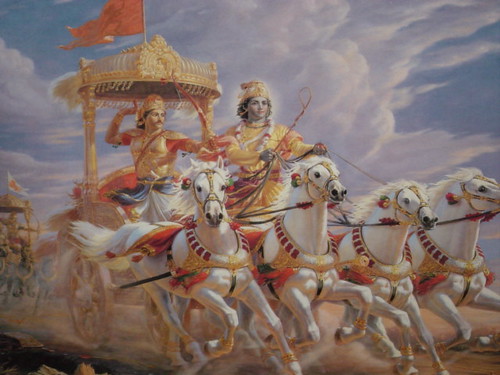
The Mahabharata itself says it quite positively.
What is found herein may also be found in other sources,
What is not found herein does not matter.
Mahabharata has also been called the Hindu bible.
Subscribe to:
Posts (Atom)